

How to Clean a Whisky Smoker: Keep Every Smoked Drink Tasting Pure
A smoked whiskey or cocktail is only truly elegant when you can taste the aroma of the wood chips in the glass, not soot or a burnt aftertaste left over from the last use. Cleaning a whiskey smoker isn't a complicated ritual, just a few consistent habits that keep the smoke, the glass and the tool itself cleaner.
Contents
- Quick answer: what should you do after every use?
- Measurable cleaning factors: time, frequency, quantity
- During practical use: how to keep the smoke and the glass clean
- By design and parts: what needs to be cleaned differently?
- Which accessory suits whom for a cleaner smoking experience?
- Common mistakes, FAQ and summary
Key takeaways
- The smoker head should be free of ash after every use, because burnt residue can quickly push the aroma in a bitter direction.
- Wood chips aren't cleaned, they're replaced: wood that has already burned won't give a clean, fresh aroma.
- The glass should be completely dry; water droplets can trap the smoke and make the aroma feel muddier.
- The quality of the butane matters: cleaner burning helps avoid unpleasant off-odours.
- Maintaining a whiskey smoker takes only a few minutes, as long as you don't let residue build up.
Quick answer: how do you clean a whiskey smoker without ruining the aroma?
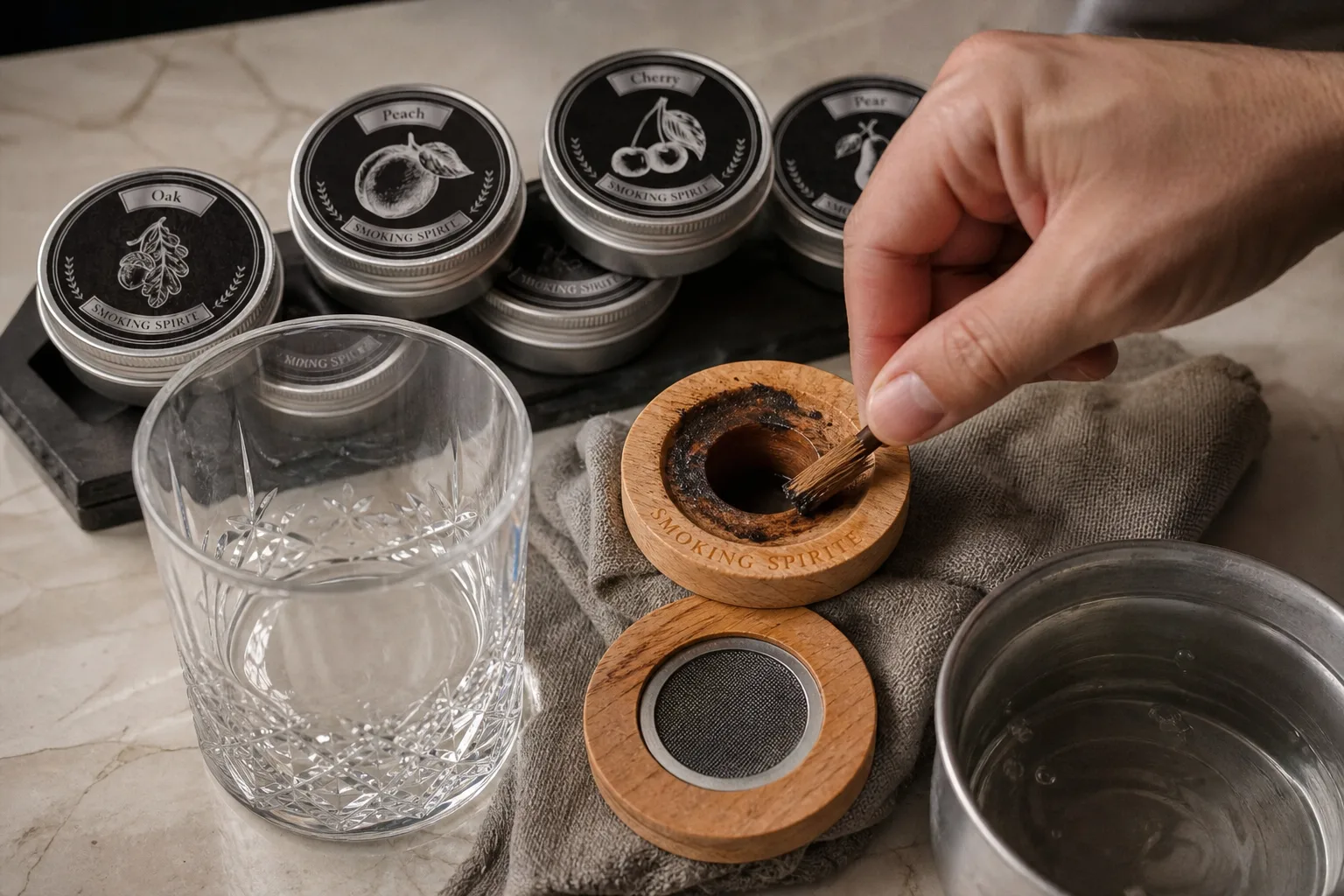
The idea of the quick routine: after use, let the tool cool down, empty out the ash, wipe the rim of the smoker head, then check the glass. Cleaning a cocktail smoker works best if you don't wait until ash, oily drink vapour and smoke residue build up into a thick layer.
A simple after-use process:
- Wait at least 2–3 minutes until the head and the burn chamber cool to a safe temperature to handle.
- Tip the used wood chips and ash onto a non-flammable surface or into an ashtray.
- Remove loose burnt residue with a soft, dry brush or cloth.
- Look at the inner rim of the smoker head: if you see a black, sticky deposit, a more thorough clean is needed.
- Wash the glass separately, then dry it completely before smoking in it again.
A dry wipe is enough when only fine, powdery ash is left in the head and there's no sticky, tar-like layer. A more thorough clean is needed when, after several drinks in a row, the inside of the smoker head becomes discoloured, the airflow narrows, or the smoke smells heavy and acrid even when lighting.
Avoid strong chemicals, long soaking and harsh scrubbing. Depending on the material of the smoker head, these can damage the surface, and the chemical smell can linger. The goal isn't a sterile, lab-like result, but that on the next smoke the smoky whiskey aroma comes from fresh wood, not from cleaning products or old ash.
Measurable cleaning factors: time, frequency, quantity
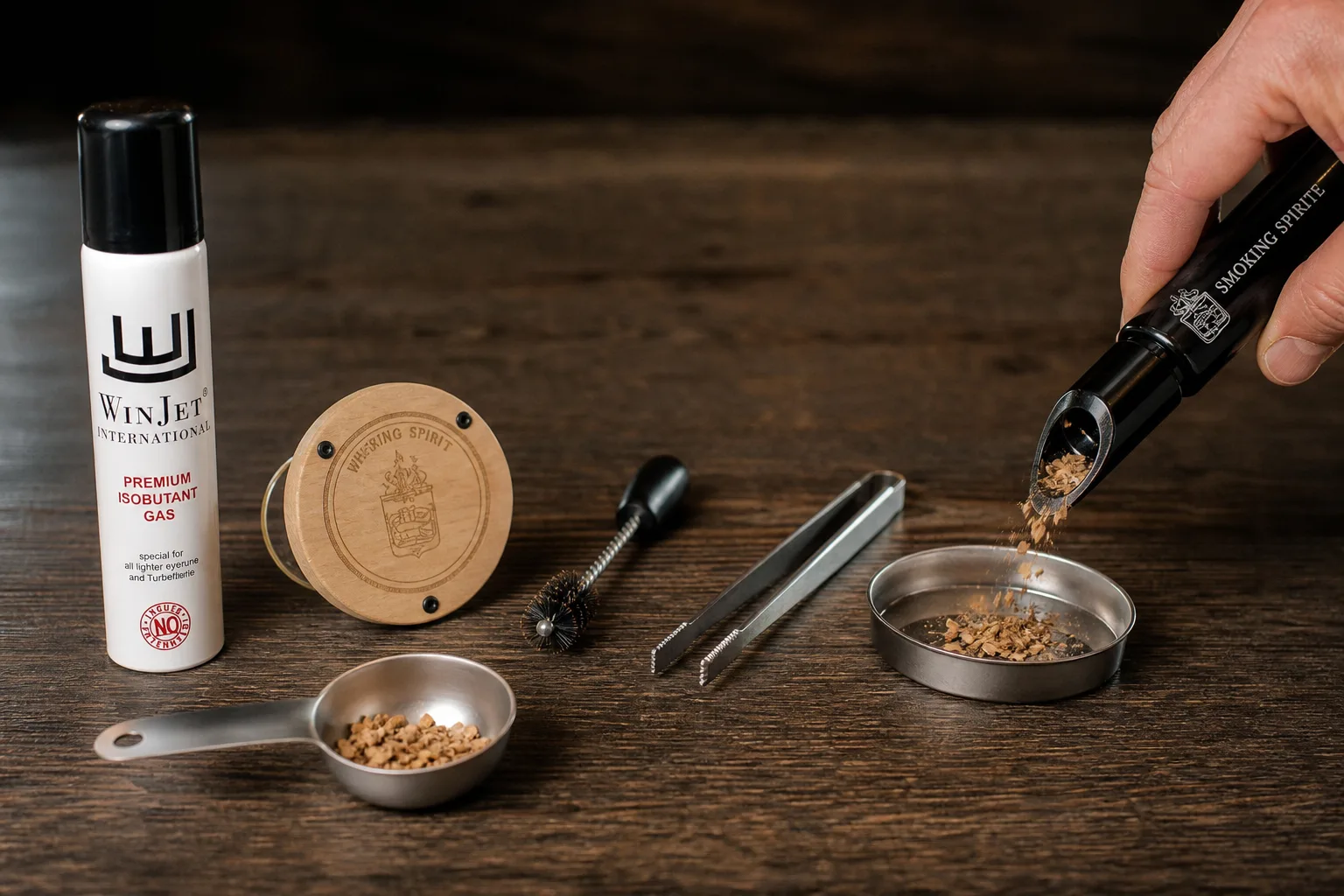
Count on 1–2 minutes per use for a quick check. This isn't a deep clean: ash out, head rim wiped, glass condition checked. If you make several drinks in one evening, it's worth pausing for half a minute every 2–3 smokes to empty the head, because built-up ash disrupts airflow.
After intensive use, a deeper clean may follow. As a general rule of thumb, after 6–10 smokes take a closer look at the burn chamber and the smoke path. If the smoke flows more slowly, the flame has trouble catching the wood chips, or dark deposits appear, don't try to "burn the system clean" with another batch of wood; clean it out.
The quantity of wood chips matters a lot. It's usually enough to cover the bottom of the head with a thin, even layer; for many smokers this equals roughly 1/4–1/2 teaspoon of chips. In an overfilled head the wood doesn't glow evenly, there can be more soot, and bitter, heavy smoke is more likely.
Butane for a whiskey smoker isn't only a matter of convenience. A stable, clean flame gives more even lighting, while an unsteady flame is more prone to sooting. So cleaning a whiskey smoker partly starts at the lighting stage: if the flame is stable and focused, less unnecessary burnt residue ends up in the head.
| Factor | Sign of clean operation | Warning sign | What to do |
|---|---|---|---|
| Wood chip quantity | Thin layer, quick glow | Heaped portion, stifled smoke | Reduce the portion |
| Smoker head condition | Dry, ash-free rim | Sticky black deposit | Clean more thoroughly |
| Flame | Stable, controllable | Flickering or sooting | Check the gas and the burner |
| Glass | Dry, odour-neutral | Water droplets or smells of dish soap | Rinse, then dry completely |
During practical use: how to keep the smoke and the glass clean
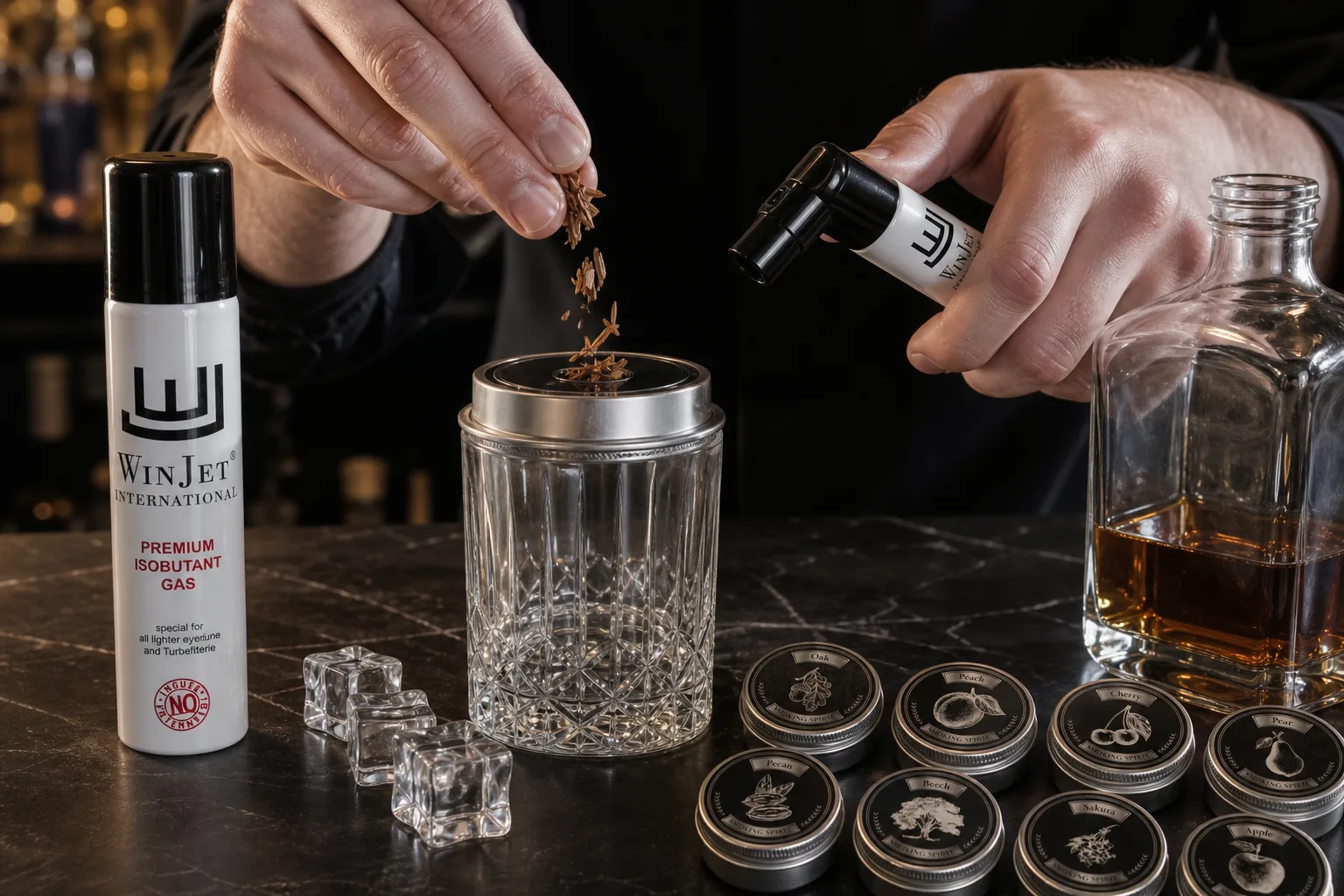
Before smoking, check three things: a dry glass, a clean head, fresh wood chips. Cleaning the whiskey glass isn't just about looks here. If the glass has a dish-soap smell, water droplets or a sugary film left from a previous cocktail, the smoke clings to it and the aroma of the drink will be less clean.
Empty the smoker head when the wood has completely turned to charcoal and no longer gives active, fragrant smoke. Don't leave it in there on a "it'll do for later" basis, because cooled ash easily scatters and ends up under the fresh chips next time. This is especially annoying if you want to work with a lighter, fruitier aroma.
With whiskey, the goal is often to bring out the barrel, woody or vanilla character, while with cocktails sugar, citrus, bitters or fruity ingredients also shape the overall impression. In an Old Fashioned-style drink, for example, the inner wall of the glass can be sugarier, so it's worth washing sooner after use. After a neat pour of whiskey there's often less sticky residue, but checking the smoker head is still necessary.
Between uses, store the tool in a dry, dust-free place. Keep the wood chips in a resealable bag or box, because wood easily picks up kitchen odours. In a smoker kit this seems minor, but if the chips absorb moisture or foreign smells, the next glass won't have the aroma you chose.
By design and parts: what needs to be cleaned differently?
The smoker head and burn chamber take the most heat, so burnt residue appears here first. Treat the rims with a soft brush, a paintbrush or a dry cloth. If the deposit is sticky rather than powdery, don't scrape it with a metal tool: loosen it instead with several short, careful cleaning rounds.
Wood chips follow a different logic: we don't wash them or dry them again, we throw them away after use. The structure of wood that has burned has already changed, a significant share of its volatile compounds is gone, and what remains gives more of an ashy, charred character. Replacing the smoking wood chips is therefore the foundation of aroma purity.
The Glasgow 330 ml whiskey glass and the Manhattan 320 ml whiskey glass deserve special attention after use, because the shape and capacity of the glass influence how much smoke stays in it for a short time. For cleaning, use warm water and a little neutral dish soap, then rinse generously. At the end, wipe it dry or let it drain completely; a wet glass isn't ideal for smoking.
With gas lighting, the point of premium, filtered butane is that the burn doesn't give off disturbing side odours. Butane by itself isn't the aroma of the glass, it's only needed for the tool to work. If you still smell gas or soot, check the burner, the fill level, and whether you're burning the same batch of wood too closely or for too long.
Which accessory suits whom for a cleaner smoking experience?
For beginners, a set that contains all the main elements needed for smoking in one place is practical. The Smoking Spirit Whiskey Smoker Kit comes with 8 different wood chips, a professional smoker and whiskey stones, for those who want to make smoked cocktails or whiskey at home. For beginners it's convenient because you don't have to pick out the basics one by one.
If you want to try more aromas, the choice of wood chips gives the most room to play. According to its description, the Smoking Spirit Wood Chips for Whiskey Smoker contains 8 kinds of wood chips: including apple, pear, cherry, Japanese cherry, apricot, oak and beech. The Fruit Selection can take you in a fruitier direction, the Oak Selection gives a woodier character; the Extra Wood Chips set is interesting if you want to switch aromas regularly.
If you smoke often, a predictable gas supply matters. The Winjet Premium Lighter Refill Gas 90 ml is a compact butane that the description recommends as fuel for the pocket torch included in the kit. For heavier use, the Passatore Prime Butane 400ML in the range may be worth considering if you'd like to refill less often.
If you're giving it as a gift, it's not just the tool that matters but the whole moment: glass, smoke, wood aroma, perhaps a recipe idea. When choosing between Smoking Spirit Set 1, Smoking Spirit Set 2 and Smoking Spirit Set 3, look at the current contents: who will be happy with an entry-level experience, and who would really make the most of more accessories, glasses or a recipe book.
Common mistakes when cleaning a whiskey smoker
The first mistake is reusing the same burnt wood chips. This is a problem because in the second round it's no longer a fresh aroma but ashy, charred residue that comes to the fore. Easily avoided: put new, dry chips in the head for every smoke.
The second mistake is too many wood chips. If the head is heaped full, the flame doesn't pass through evenly, the smoke can be heavier, and more soot can form. Stick to a thin layer and go for a short, controlled smoke.
The third mistake is using a wet glass or wet tool. Water can trap the smoke, and the aroma can be less clean and duller. Wipe the glass dry before smoking, and only use the smoker head when it's dry.
The fourth mistake is a strongly scented cleaning product. The smell of a perfumed dish soap or an aggressive chemical can easily settle on the glass. Choose neutral cleaning, thorough rinsing and complete drying.
The fifth mistake is not paying attention to the flame. Holding it on one spot for too long can needlessly char the chips and put more strain on the rim of the head. Work with short, targeted lighting, and once the wood is glowing, don't keep burning it without reason.
Frequently asked questions
How often should you clean a whiskey smoker?
After every use, it's worth at least emptying the ash and wiping the head dry. A more thorough clean is needed if you see a dark, sticky deposit or the smoke no longer smells clean. With intensive use, check the burn chamber every few smokes.
Can the smoker head be washed with water?
This depends on the material and design of the particular head, so the tool's instruction manual always comes first. As a general rule, remove ash and dry residue with a dry brush or cloth. If water does get on the tool, only use it again once it's completely dry.
Why does the drink taste bitter or too smoky?
Common causes are too many wood chips, reused burnt wood, or old ash left in the head. Burning the same batch for too long can also cause heavy smoke. Try working with a smaller amount, fresh chips and a shorter smoking time.
Is it enough to just rinse the whiskey glass?
If it only held neat whiskey, a thorough rinse can sometimes be enough, but after smoking it's better to finish with neutral washing and a generous rinse. For cocktails, washing is especially important, because sugar, citrus and other ingredients can leave a film. Before the next use, the glass should be completely dry.
When should you replace wood chips?
Fresh wood chips are recommended for every smoke. If the chips are already black, charred or have crumbled to ash, they're not suitable for another smoke with a clean aroma. Replacing them is a faster and better solution than trying to "rescue" old wood.
Does the type of butane I use matter?
Yes, because the stability and cleanliness of the flame can influence how controlled the burn of the wood chips is. The purpose of premium, cleaner butane is that the burn doesn't carry disturbing side odours near the drink. If you notice sooting or a strange smell, also check the lighter, the fill level and the amount of wood chips.
Summary
Cleaning a whiskey smoker becomes a natural part of the evening ritual when you see it not as a separate chore but as protecting the experience. Fresh wood chips, a dry glass, a clean smoker head and stable butane lighting: that's all it takes for the aroma of your chosen wood to shine in the glass. If you pay attention to these, the smoke won't mask but nicely complement the character of the whiskey or cocktail.
Our recommended products


