

Jet Lighter Not Working? How to Choose the Right Butane Refill
When a jet lighter stops working, it's easy to assume the ignition head is broken. With whisky or cocktail smoking, though, the problem is very often the butane gas, the gas pressure, the way you refill, or how long you let the lighter rest after refilling. Here's how to check it quickly, and which lighter refill gas to choose for a stable, clean jet flame.
Contents
- Quick answer: why isn't my jet lighter working?
- Measurable checks: gas level, pressure, fill time, flame height
- What lighter refill gas does a jet lighter need?
- Refilling and using it for whisky or cocktail smoking
- Which refill and accessory is right for whom?
- Common mistakes and customer questions
- Frequently asked questions
Key takeaways
- If the jet flame won't light but you can see a spark, the problem is often not the ignition but the gas supply.
- For a jet lighter, choose premium butane gas, especially for drink smoking, where the purity of the aroma matters.
- After refilling, it's usually worth waiting a few minutes before you light the lighter.
- A flame that is too low or too high can both make it harder to ignite wood chips.
- For whisky smoking, a stable, concentrated jet flame is more practical than a traditional soft flame.
Quick answer: why isn't your jet lighter working, and what should you try first?
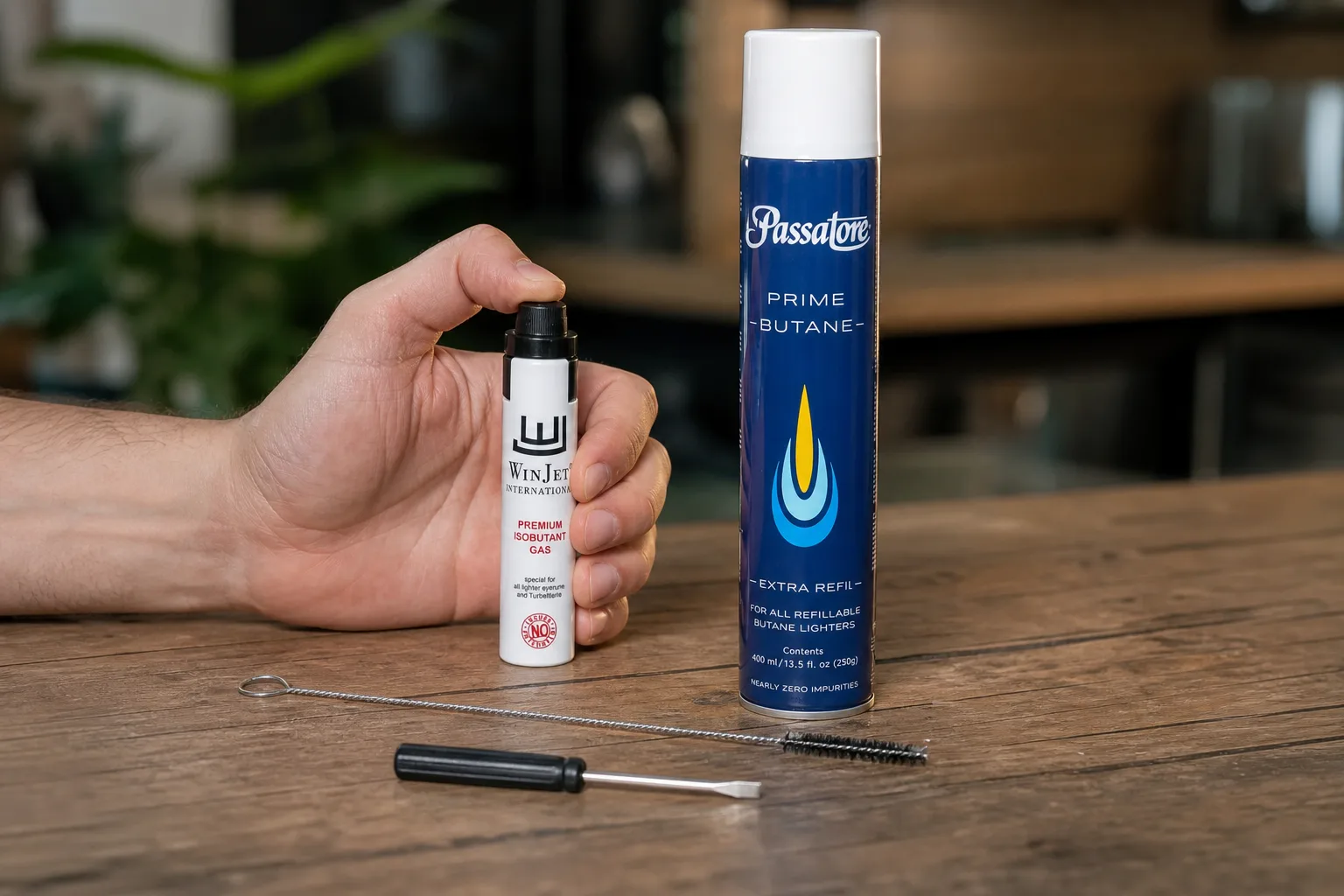
No flame? Check the gas level and refill quality first
A jet lighter works well when the tank holds enough butane, the valve lets the fuel through cleanly, and the pressure is high enough to form a concentrated flame. If the lighter clicks but no flame appears, your first check shouldn't be taking it apart but looking at the gas level and the refill.
With most small jet lighters, an empty or nearly empty tank shows up as a flame that first shortens, then starts to sputter, and finally disappears completely. If it doesn't improve after refilling, air may have got into the tank, or the refill valve may not have lined up exactly with the canister nozzle. In that case, purging and refilling often does more than turning the flame adjustment screw.
Sparks but no ignition: often it's the gas supply, not the ignition
A spark only shows that the ignition mechanism is producing an ignition point. A jet flame also needs proper gas flow. If you can see a spark but nothing ignites, listen for a short hiss when you press the button. If there's no sound, the gas isn't getting out properly; if there is a sound but the flame only flashes, the cause could be pressure, air in the tank, or a flame setting that is too low.
With a whisky smoker lighter this is especially annoying, because a momentary flame isn't enough to ignite wood chips. The goal is a flame you can hold steadily in one spot for a few seconds.
Why is a stable jet flame especially important for whisky smoking?
In cocktail smoking and whisky smoking, the flame doesn't touch the drink directly; it starts the wood chips. A stable jet flame is practical because it delivers concentrated heat on a small area, making it easier to bring the wood chips to an even glow. If the flame is erratic, the smoking becomes less predictable too: sometimes too little smoke, other times the chips suddenly get a blast of heat.
The Smoking Spirit experience is built on controlling the smoky aroma. The brand's range includes 8 types of wood chips, so the same drink can take on different characters; for that, though, the ignition has to work reliably too. Good gas isn't a showy extra, but one of the foundations of the whole evening ritual.
Measurable checks: how to tell whether gas is the problem
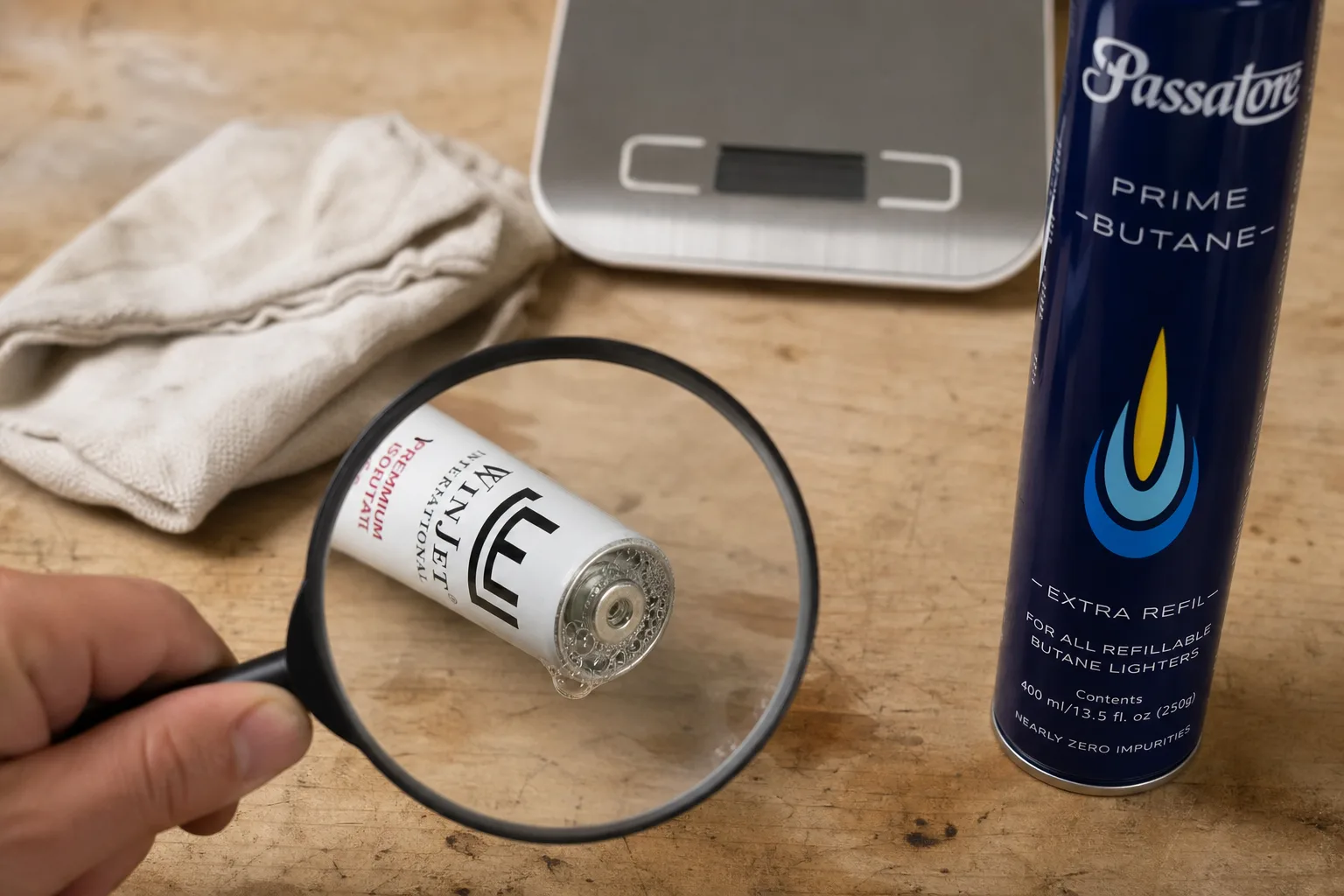
Gas level and pressure: when is a lighter empty or weak?
Many jet lighters have no transparent tank, so you can't always check the gas level at a glance. Practical signs include a flame that dies after 1–2 seconds, a visibly fluctuating flame height, or only a weak hiss when you press the button. All of these can indicate low gas, or air in the tank reducing the pressure.
Butane pressure also depends on temperature: in a cool place the gas behaves less lively. At room temperature, roughly 18–25 °C, a jet lighter generally works more predictably. If you stored it in a cold car, on a terrace or in an unheated room, let it warm up before use, but never put it on a direct heat source.
Fill time: how many seconds should you fill a jet lighter?
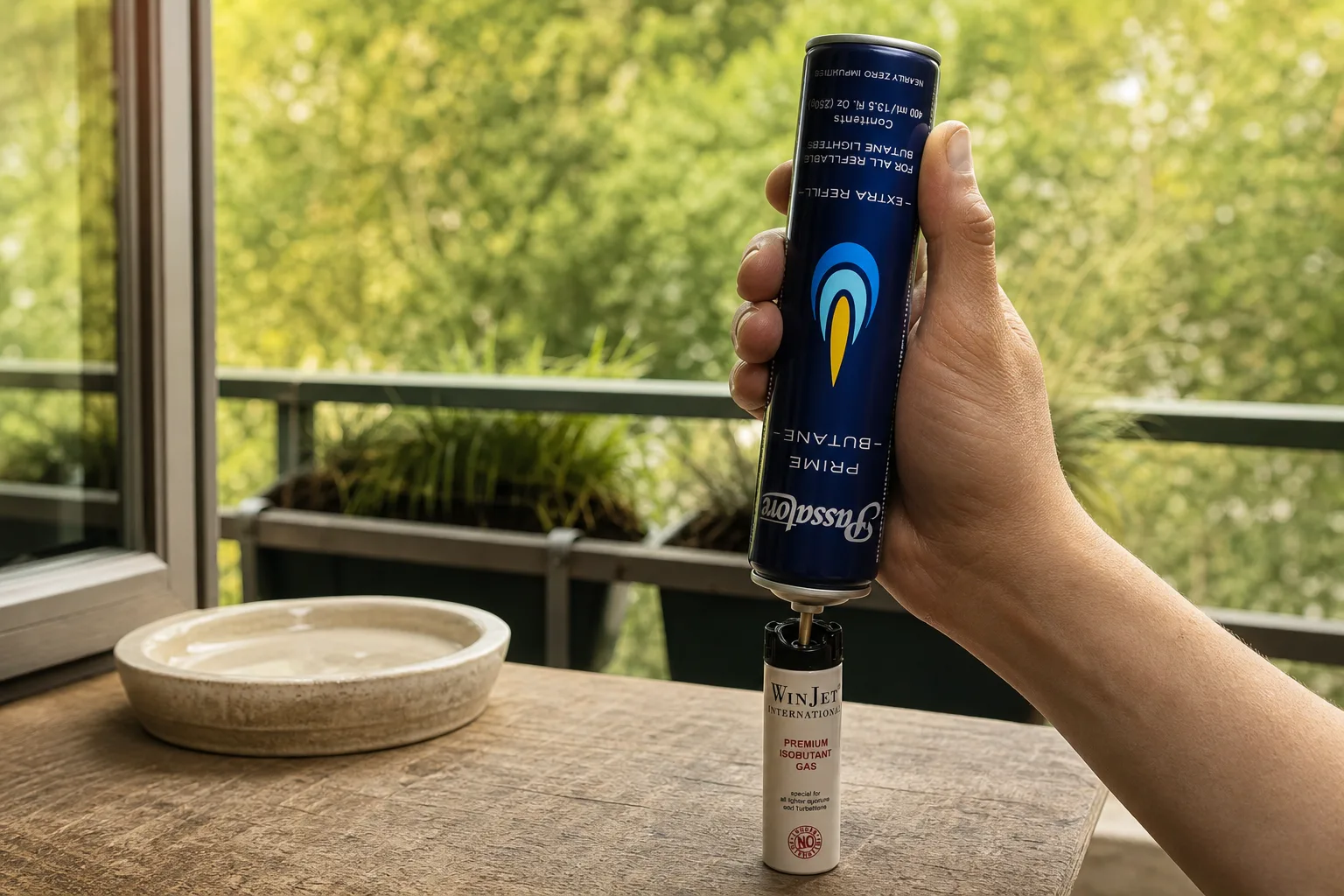
For smaller jet lighters, a fill time of 5–10 seconds is usually enough for one filling cycle. A larger tank may take longer, but don't force it: if gas starts to spray back or leak around the valve, the tank is probably full or the nozzle isn't seated properly.
It's important that during filling both the lighter and the canister are held upside down, vertically, and that the valves meet precisely. If you press the canister on at an angle, some of the gas escapes and the tank won't fill properly.
Rest time after refilling: why wait before lighting?
After refilling, a rest of 2–5 minutes is generally recommended. During this time the gas and pressure in the tank stabilize, and any butane that condensed on the outside of the lighter can evaporate. If you try to light it immediately, the flame may flash and die, or the cold valve may cause uneven gas flow.
For safety, always refill in a well-ventilated place, away from open flames and hot surfaces. Butane is flammable, so those few minutes of waiting aren't an inconvenience but a natural part of using the lighter.
Flame height and adjustment: when is the flame too small, too big or unstable?
At the bottom of jet lighters you'll often find a flame adjustment screw or dial. For igniting wood chips, a well-focused jet flame of about 2–4 cm is generally practical: strong enough for quick ignition, yet easy to direct. If the flame is barely visible or goes out immediately, increase the setting carefully. If it's too long, hissing and hard to control, turn it down.
Always adjust in small steps. Even a quarter turn can make a noticeable difference, especially on smaller lighters. If you still can't get a stable flame at the maximum setting, don't push it: check the filling, the purging and the gas quality instead.
What lighter refill gas does a jet lighter need?
Premium butane gas: why is it better for a cleaner, more stable burn?
Butane is the basic fuel for a jet lighter. For drink smoking it's especially important that the burn doesn't give off an unpleasant smell or aftertaste, because the whole point is for the aroma of the smoked wood to come through. Choosing premium butane is therefore not just a technical question but a decision that protects the experience.
Lower-quality, more contaminated gas can leave deposits around the valve over time and result in a more erratic flame. That doesn't mean every fault is down to the gas, but if your jet lighter keeps working unreliably after refills, it's worth trying a better-quality gas first.
| Gas selection factor | Basic butane gas | Premium butane gas | Why does it matter for whisky and cocktail smoking? |
|---|---|---|---|
| Burn cleanliness | Can vary | Aims for a cleaner burn | The aroma of the wood chips stays in the foreground |
| Jet flame stability | May be more sensitive to impurities | Can help with more consistent performance | Easier to ignite the wood chips precisely |
| Strain on valve and nozzle | May be more prone to deposits | May be a gentler choice | Fewer hiccups while smoking |
| User experience | May be enough for occasional lighting | Better fit for ritual-style use | A steadier process when entertaining guests, too |
90 ml or 400 ml: which is worth it for occasional and regular use?
The advantage of the smaller 90 ml canister is its compact size. It's practical if you smoke whisky or cocktails less often, or if you're looking for an easy-to-store refill to go with a gift. It takes up less room in a bar cabinet, a kitchen drawer or a gift pack.
The 400 ml size is more convenient for those who use their smoker kit regularly, host guests, or make smoked drinks on many occasions. The advantage of the larger canister is that you need to buy a new refill less often, so you're less likely to run out of gas halfway through making an evening cocktail.
Compatibility: what to look out for at the fill valve and when using the smoker
Most jet lighters have a standard-type refill valve at the bottom, but the fit can differ from canister to canister and lighter to lighter. Before filling, check that the canister nozzle sits firmly on the valve. If most of the gas escapes sideways, it may not be filling properly.
When using the smoker, it's also important that the lighter is easy to aim. Wood chips are best lit with a short, targeted flame rather than burned for a long time. The aim is glow and smoke, not setting the wood chips excessively ablaze.
When is refilling not enough, and when should you suspect another fault?
If there's no improvement after a fresh fill, a rest and careful flame adjustment, another fault may be behind it. This could be a clogged nozzle, a damaged fill valve, a worn ignition mechanism or a mechanically stuck button. If you can clearly hear the gas flowing but no spark appears, the problem is more likely in the ignition part.
If, on the other hand, there's a spark but no smell of gas or hiss, the gas supply is still the more likely issue. In that case, purging and then refilling is the most sensible next step.
Refilling and using it in practice for whisky or cocktail smoking
Safe refill sequence: purge, fill, rest, test-light
Refilling a jet lighter becomes more reliable if you always follow the same sequence. Don't automatically add gas to a tank that is half full of air, because the air left inside can reduce the usable pressure.
- Turn the flame adjustment to a lower setting and make sure there is no open flame nearby.
- Using a thin, non-sparking tool, briefly press the lighter's refill valve so that any remaining gas and air can escape.
- Turn the lighter and the gas canister upside down, then fill, generally for 5–10 seconds.
- Wipe off the outside if gas has condensed on it, then wait about 2–5 minutes.
- Carefully set the flame height and do a short test light.
- Only start igniting the wood chips once the flame is stable.
Igniting wood chips: how does a stable jet flame help with even smoking?
When igniting wood chips, the aim isn't for them to burn with a big flame but to start glowing in a controlled way. For this, use the jet flame briefly, pointed at one spot, then watch whether smoke starts to rise. If the chips don't get enough heat, you only get a faint scent; if a strong flame hits them for too long, the smoke can turn harsher.
For cocktail smoking a smaller amount of wood chips can be enough, and for whisky smoking you can match the wood type to the character of the drink. The fruity and oaky wood chips in the Smoking Spirit range can give different aromas, so stable ignition helps make sure the result isn't left to chance.
Use cases: an evening whisky ritual, hosting guests, a smoker kit received as a gift
In an evening whisky ritual, predictability matters: you shouldn't have to experiment with the lighter once you've already poured the drink. When hosting guests it's even more important that the jet flame works first time, because the spectacle of smoking is part of the experience. And with a smoker kit received as a gift, the first use often decides how much it becomes a regular habit.
Smoking Spirit was founded by passionate grill and whisky enthusiasts, and the concept grew out of grill and whisky culture. The smoking experience really works when the kit, the wood chips and the lighter gas function not as separate items but as parts of one evening ritual.
Fast delivery: when you need a solution for the next occasion
If you find out ahead of the next evening with friends or a gift occasion that the gas has run out, getting it quickly is a practical concern. Smoking Spirit offers fast delivery. This is especially convenient if you don't want to hunt for the right butane gas for your lighter in a separate shop at the last minute.
The 45-day, no-questions-asked return option also lowers the risk of a first order. Smoking is an experience product: what matters in your decision isn't only whether it works, but also how well it fits your evening drink routine.
Which refill and accessory is right for whom?
For occasional smoking: Winjet premium lighter refill gas 90 ml
If you make smoked whisky or cocktails a few times a month, the compact canister may be the more convenient choice. The Winjet premium lighter refill gas 90 ml is available at 1,490 HUF, and according to its description it is made for the pocket dragon included in the kit, with a universal filling nozzle. Based on the product description, it is clean, high-quality butane gas, intended to avoid unpleasant smell or aftertaste during burning.
For regular whisky and cocktail smoking: Passatore Prime Butane 400 ml
If you use your smoker often, or regularly make smoked drinks for guests, the larger canister is more practical. The Passatore Prime Butane - premium lighter refill gas - 400ML is listed in the range at 1,990 HUF and, according to its description, is 5-times filtered butane gas of extremely high purity. The larger 400 ml volume is convenient if you don't want to look for a new canister every few uses.
With a gift or a first order: glass and gas together
For a first smoking experience, it can be a good idea to get the drinking glass and the gas needed for refilling in the same package. The pre-order gift in the listed range consists of a glass and gas, valued at 6,000 HUF. This is useful for those who want to give not just a single tool but a more complete starter experience as a gift.
For the full experience: smoker kit, wood chips and stable gas supply together
The Whiskey Smoker Set is listed at 27,990 HUF and gives you the most when used together with suitable wood chips and a stable gas supply. Smoking Spirit Wood Chips for Whiskey Smoker are available at 5,490 HUF, and the Extra Wood Chips set is listed as an 8-piece collection. If you like to experiment, the advantage of the 8 types of wood chips is that you can take the same drink in several smoky directions.
Common mistakes when a jet lighter isn't working
Skipping the purge before filling
If air stays in the tank, the usable gas pressure can be weaker. As a result the lighter seems full yet only lights briefly. Avoid this by briefly releasing the remaining gas and air through the valve before filling.
Lighting immediately after filling
After filling, the cold gas and fresh pressure can make the flame unreliable. If you try right away, you can easily think the lighter is faulty. Wait 2–5 minutes, and only then do a test light.
Flame setting too high
A jet flame that is too high is harder to control and can deliver too much heat to wood chips. That doesn't give you more elegant smoking, just more hurried use. Adjust the flame gradually and stay in a range you can easily control.
Poor fit at the fill valve
If the canister nozzle sits at an angle on the lighter's valve, some of the gas escapes. The tank then doesn't fill properly, and flammable gas needlessly ends up in the surrounding air. Always press the two valves together vertically, firmly but without forcing.
Using low-quality or more contaminated gas
The nozzle of a jet lighter can be more sensitive than that of a traditional lighter. If the gas is more contaminated, the flame may sputter and the area around the valve can become problematic more easily. For drink smoking, it's therefore worth choosing cleaner, premium butane gas.
Frequently asked questions
Why does my jet lighter spark but not light?
If there's a spark but no flame, the gas supply is often the problem. Check whether you can hear a hiss when you press the button, then purge and refill. If there is gas but no spark, the ignition mechanism is more likely to be faulty.
Why does the flame go out immediately after refilling?
After filling, the pressure and temperature of the gas aren't always stable yet. Generally wait 2–5 minutes before lighting again. If it still goes out after resting, check the flame setting and the quality of the fill.
Can poor-quality gas cause a weak or sputtering flame?
Yes, more contaminated gas can contribute to sputtering, especially in jet lighters. Premium butane gas can support a cleaner burn and more reliable use. In whisky and cocktail smoking this matters all the more, because the aroma of the drink takes centre stage.
How long should I wait after refilling before the first light?
Generally, waiting 2–5 minutes is practical. During this time the gas stabilizes, and any butane that has condensed can evaporate from the outside of the lighter. Always do the test light away from open flames, in a well-ventilated place.
How often do I need to refill if I use it for whisky smoking?
That depends on how often you smoke, the size of the lighter's tank, and how long you use it each time. If the flame gets shorter, sputters, or igniting the wood chips noticeably slows down, it's time to check the gas level. For regular use, it's worth keeping a spare canister at hand.
Why shouldn't I smoke wood chips with too high a flame?
A flame that is too high is less controllable, and the wood chips can quickly be hit by too much heat. In smoking, the aim isn't a strong flame but an even glow and pleasant smoke production. With a short, focused jet flame you can work more precisely.
Summary
If your jet lighter isn't working, don't automatically replace it: check the gas level, purge, fill properly, then wait a few minutes before the test light. For whisky and cocktail smoking, clean butane gas, a stable jet flame and well-chosen wood chips together give you the premium, smoky experience that makes the ritual truly memorable.
Our recommended products


